
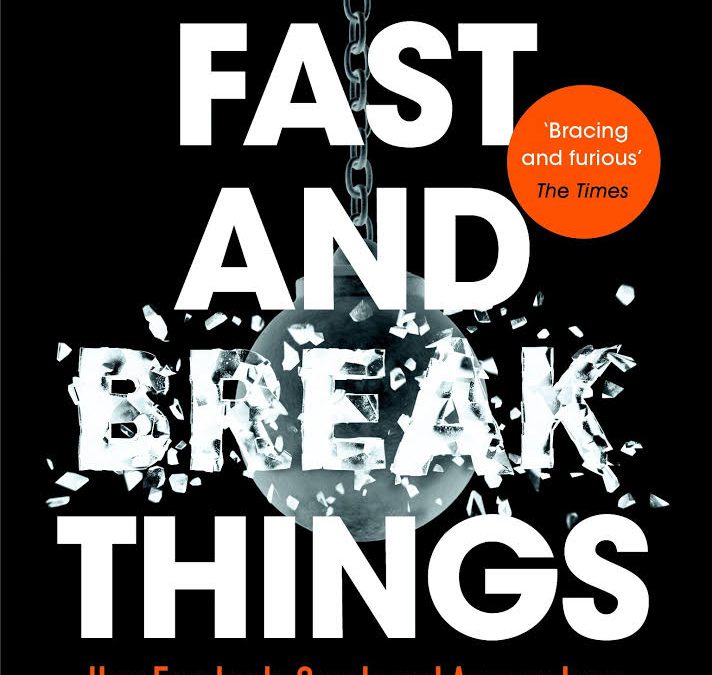
I’ll be honest — I went into this book a little skeptical. Tech criticism has become its own cottage industry, and a lot of it follows a predictable script: Silicon Valley bad, the internet broken, democracy endangered, see you in the footnotes. Jonathan Taplin’s Move Fast and Break Things looked, from the outside, like it might be another entry in that genre. It isn’t.
What separates it is where Taplin is standing when he writes. This is not a journalist who studied the music industry from a distance. He managed tours for Bob Dylan and The Band. He produced Martin Scorsese’s Mean Streets. He spent half a century inside the cultural economy he’s describing, and when he says the digital revolution gutted it, he’s not theorizing — he’s reporting from the scene of the crime. That biographical weight changes how the book reads. The anger doesn’t feel performed. It feels earned.
The argument itself is clear-eyed and structurally tight. A small group of libertarian-leaning entrepreneurs in the 1990s, Taplin argues, hijacked what was supposed to be a decentralized, open internet and built three companies — Google, Facebook, and Amazon — that now function as monopoly gatekeepers for music, film, journalism, and publishing. Musicians earn fractions of cents per stream on platforms generating billions in revenue. Search algorithms that could be adjusted to stop surfacing pirated content are not adjusted, because pirated content drives traffic. The advertising money that once sustained newsrooms has migrated almost entirely to two platforms that produce no journalism themselves.
None of this is framed as accident. Taplin traces a specific ideology — a strain of Ayn Rand-inflected libertarianism, most visibly embodied by Peter Thiel — that treats government oversight as illegitimate and monopoly not as a problem to be regulated but as a goal to be pursued. The philosophy has a face and a history, and pinning it down that precisely is one of the book’s real contributions. It’s harder to shrug your shoulders at “disruption” once you’ve understood what’s actually driving it.
Taplin is also quietly devastating on the language Silicon Valley uses to describe itself. “Openness,” “democratization,” “the free flow of information” — he unpacks these terms not as neutral descriptions but as ideological cover. The gap between the rhetoric and the material reality for working artists and journalists is the book’s emotional core, and he handles it without being shrill about it, which is harder than it sounds.
Where the book is less sure-footed is in the final stretch. The solutions he proposes — artist cooperatives, reformed copyright enforcement, antitrust action — feel a little modest after two hundred pages of describing a structural crisis. There’s also a tendency to hold the counter-arguments at arm’s length. The ways digital platforms have genuinely opened up distribution for artists who would never have gotten near a traditional label or publisher get acknowledged but not really grappled with. For a book this confident in its diagnosis, the ambivalence about complexity occasionally feels like an evasion.
But here’s what stayed with me: Taplin published this in 2017, and nearly everything he worried about has gotten worse. The companies are larger. The creative economy is more thoroughly reorganized around their platforms. The political consequences of surveillance advertising and algorithmic news distribution are no longer hypothetical. Reading it now, the book feels less like a warning and more like a memo from the recent past explaining exactly how we got here.
If you work in media, music, publishing, or journalism, this is not background reading — it’s a direct account of the forces reshaping your industry. But honestly, it’s worth your time even if you don’t. Taplin’s core question — who does the internet actually serve, and how did it end up that way? — is one that belongs to all of us. He makes it impossible to look away from, which is no small thing.