
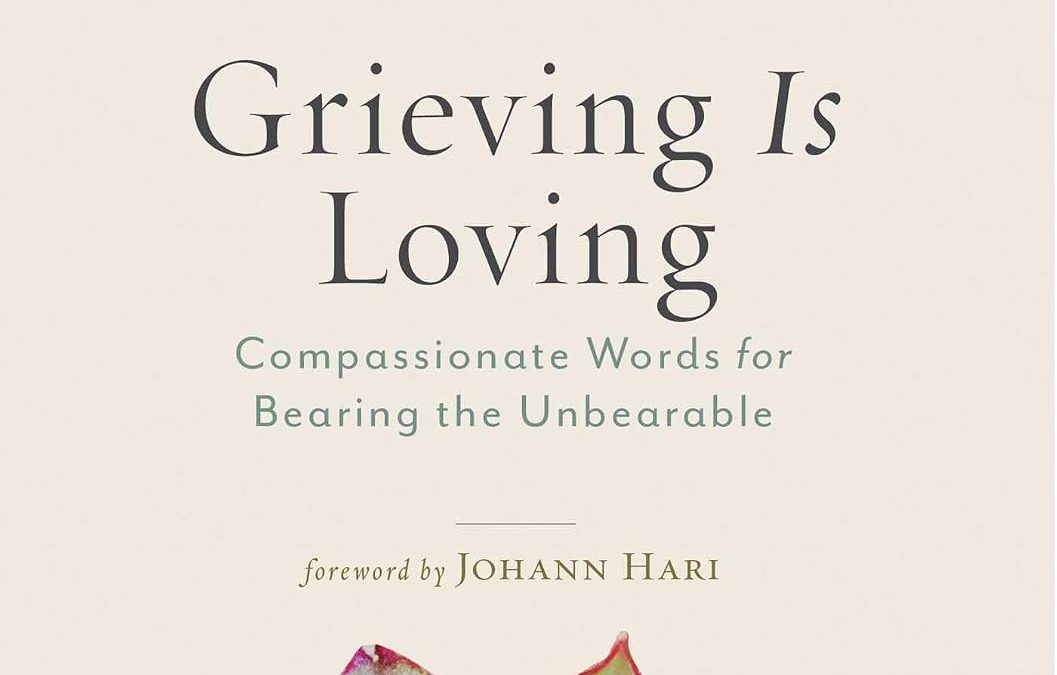
I’ll be honest—when I first picked up Grieving Is Loving, I expected a book about how to survive grief: something that would explain the stages of mourning, offer comforting advice, and perhaps tell the reader how to slowly return to ordinary life after losing someone. This book is different. Joanne Cacciatore does not approach grief as a problem that needs to be solved. She approaches it as something that must be experienced, carried, and understood.
And that distinction matters.
Grieving Is Loving: Compassionate Words for Bearing the Unbearable is a short book, but its subject is enormous. Published by Wisdom Publications in 2020, the book consists of reflections, quotations, poems, and short passages designed to be read slowly and returned to repeatedly. It draws on Cacciatore’s earlier work, Bearing the Unbearable, while also introducing new material.
This is not necessarily a book that asks you to sit down and read one hundred and thirty-six pages from beginning to end. It is deliberately fragmented. A reader can open almost anywhere, read a page, stop, return later, and allow a particular sentence or reflection to remain with them. The publisher describes it as a companion that can be carried through the day, particularly because grief can make sustained concentration difficult.
The book understands something that many discussions of grief forget: when someone is grieving, reading itself can become difficult. There is therefore something almost fitting about the book’s form. Its short passages do not demand much from the reader. They do not require concentration for long periods or ask the grieving person to construct a complicated argument. Instead, they offer small spaces in which the reader can pause.
But beneath this simple structure is a much deeper argument. Cacciatore’s central idea is contained in the title itself: grieving is loving. The statement initially sounds almost obvious. We grieve because we have lost someone we loved. Yet the book takes this idea further. Grief is not presented merely as the unpleasant consequence of love. It is presented as evidence of love itself. The pain exists because the relationship mattered. The absence hurts because the presence mattered. The loss is unbearable because the person was not replaceable. This changes the question we ask about grief. Instead of asking, How do I make this pain disappear?, the book encourages a different question: What does this pain tell me about what I have loved? That is where the book becomes much more than a collection of comforting words.
One of Cacciatore’s strongest challenges is directed toward the cultural expectation that grief should eventually be left behind. The book resists the idea that there is a correct timetable for mourning or that the purpose of grieving is simply to return a person to the emotional state they occupied before the loss. Publishers Weekly similarly describes Cacciatore’s approach as encouraging readers to fully inhabit grief rather than accepting narratives that pathologize the experience. This is perhaps one of the book’s most important contributions. We often speak about grief using the language of recovery. We ask whether someone is “doing better.” We wonder whether they have “moved on.” We sometimes become uncomfortable when grief continues longer than we expected. But these expressions can quietly transform grief into something resembling an illness from which a person is expected to recover.
Cacciatore asks us to reconsider that assumption. Perhaps grief is not evidence that something has gone wrong. Perhaps sometimes it is evidence that something mattered profoundly. Becareful The book does not romanticize pain, but it refuses to treat pain as meaningless. This distinction is important.
There is a danger in romanticizing grief—to suggest that suffering is automatically beautiful or that devastating loss is somehow necessary for personal growth. Cacciatore’s approach is more complicated. She does not make grief easy. She does not promise that every loss will eventually reveal a satisfying lesson. Instead, she gives the experience of grief permission to remain difficult. That honesty is one of the book’s greatest strengths.
Grief can be contradictory. A person can be grateful for having known someone and devastated that they are gone. A person can laugh one afternoon and collapse into sadness the next. A person can feel peaceful and guilty for feeling peaceful. A person can continue living while simultaneously feeling that an essential part of life has disappeared. These contradictions are not necessarily signs that grief is being experienced incorrectly. They are part of what makes grief so difficult to understand.
The book’s refusal to force grief into a neat emotional sequence is particularly powerful.
Cacciatore’s reflections repeatedly return to the relationship between grief and love, but also between grief and identity. Losing someone does not simply mean losing their physical presence. It can change the structure of everyday life itself. A chair becomes empty. A name becomes difficult to hear. A familiar routine becomes strange. A future that once seemed certain suddenly becomes impossible. The world continues, but the person experiencing the loss may no longer encounter that world in quite the same way. This is one reason the book’s language of “bearing” is so meaningful.
The objective is not necessarily to conquer grief. It is to bear it. To carry something that cannot be removed. To learn that some forms of pain cannot be solved in the ordinary sense. There are wounds that do not need to disappear in order for life to continue. That may be one of the hardest ideas in the book.
Modern culture often encourages us to think in terms of solutions. Problems should have answers. Difficult emotions should be managed. Pain should be reduced. Difficult experiences should eventually produce growth. But death refuses this logic. There is no technique that can return a dead person to life. There is no psychological strategy that can make absence become presence again. There is no final sentence capable of explaining why one particular person had to die. The book is powerful partly because it does not pretend otherwise. Instead, it asks what it means to continue living when something irreversible has happened.
This is also why the book’s short, fragmented structure works surprisingly well.
Grief itself is rarely experienced as a perfectly organized narrative. Memories arrive unexpectedly. A song can bring someone back. A smell can produce an entire moment. A photograph can suddenly make the absence feel new again. The mind does not necessarily move through grief in straight lines. Neither does this book.
Its collection of meditations, quotations, poems, and reflections allows the reader to encounter grief in fragments rather than as a carefully organized theory. Publishers Weekly notes that the main body of the book consists of stream-of-consciousness meditations interwoven with words from writers including James Baldwin, Kahlil Gibran, C. S. Lewis, Mark Twain, and Rumi.
This creates one of the book’s most distinctive qualities: it feels less like being taught about grief and more like being accompanied through it. And perhaps accompaniment is more appropriate than instruction. Someone who is grieving does not necessarily need another person to explain death to them. They may need someone who can tolerate the silence around it. They may need someone who does not immediately try to make the situation better. They may simply need to hear that what they are experiencing does not make them weak, broken, or abnormal.
This is where Cacciatore’s own experience and professional work become relevant. She is a professor at Arizona State University whose work focuses on traumatic loss and grief, and she founded the MISS Foundation, an organization serving bereaved families. She also experienced the death of her daughter, Cheyenne, in 1994. That combination of professional knowledge and personal experience shapes the tone of the book. It does not read like a detached academic examination of bereavement. Nor does it read simply as a personal memoir. It occupies a space somewhere between reflection, wisdom literature, poetry, and grief support.
Its greatest strength is therefore also its greatest limitation.
Readers looking for a systematic psychological account of grief may find the book insufficiently structured. It does not provide a comprehensive theoretical framework, nor does it attempt to explain every dimension of bereavement. It is not a clinical manual, and it should not be read as one. Its purpose is different. It is a companion. That makes it particularly useful for moments when a longer, more analytical book feels impossible to read. But it also means that readers seeking empirical evidence, detailed psychological explanations, or practical therapeutic exercises will need to look elsewhere.
The book’s reliance on quotations and short meditations can also feel repetitive at times. Some readers may find its spiritual and contemplative language deeply meaningful, while others may prefer a more psychological or evidence-based approach. Yet even this limitation reveals something about the book’s purpose. Cacciatore is not trying to explain grief from a distance. She is trying to sit beside it. And perhaps that is the reason the book’s central idea stays with the reader.
Grief is not the opposite of love. It is what remains when love has lost its ordinary physical form. The person is no longer there to speak to, touch, call, or meet. But the relationship does not simply vanish because the person has died. Memory remains. Habits remain. Stories remain. Objects remain. The influence of that person remains in ways that can be impossible to measure. The relationship changes, but its significance does not necessarily disappear.
This is where the title becomes more profound than it first appears. Grieving Is Loving does not mean that suffering should be celebrated. It does not mean that people should remain trapped in sorrow. And it does not mean that grief must always be painful in order to prove that love was genuine. Rather, the title suggests that grief and love belong to the same human experience. Where there has been attachment, there can be absence. Where there has been presence, there can be longing. Where someone has occupied an important place in our life, their disappearance can leave an equally significant absence.
Love creates bonds. Death does not simply erase them; it changes the way we experience them.
Grieving is loving—not because grief is beautiful, but because the depth of the grief can reveal the depth of what mattered.