
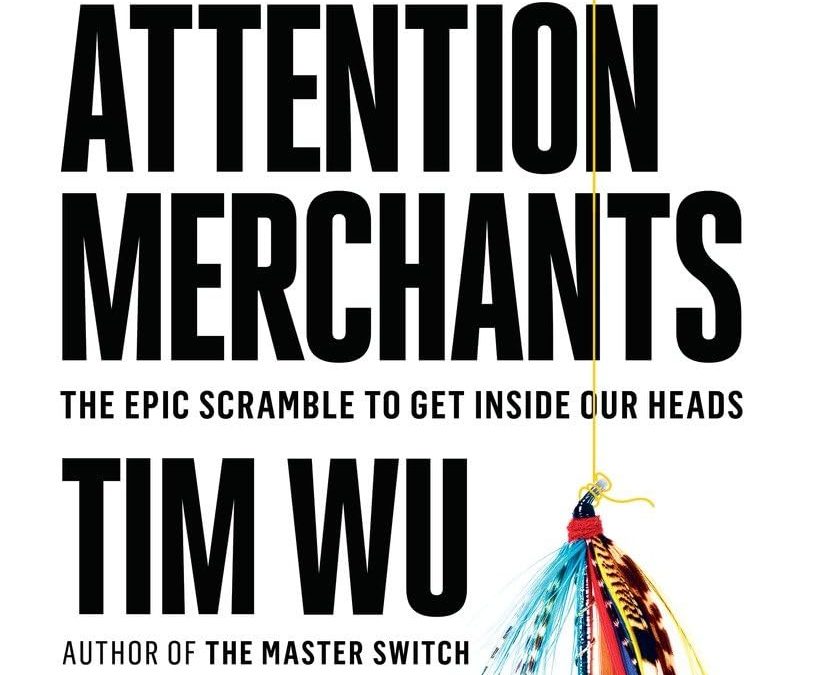
The Big Idea: The battle for human attention has a long history—and understanding it reveals how modern tech platforms operate.
Columbia Law professor and tech policy expert Tim Wu traces the “attention economy” from its 19th-century origins to the present day. The book reveals that today’s social media tactics aren’t new—they’re the latest iteration of a 150-year-old business model: capture attention, then sell it to advertisers.
Wu chronicles how newspapers pioneered clickbait with sensational headlines, how radio invented the commercial interruption, how television refined the art of holding eyeballs, and how the internet perfected attention capture at an unprecedented scale. Each evolution made the system more sophisticated, more invasive, and harder to resist.
What Works: Wu’s historical approach provides crucial context often missing from tech criticism. The book shows that many “problems” attributed to social media—sensationalism, manipulation, invasion of private life—have deep roots. This perspective helps distinguish what’s genuinely new about digital platforms from what’s simply the same old tricks with better technology.
The writing remains accessible and engaging throughout. Wu uses vivid examples and compelling personalities—from P.T. Barnum to Mark Zuckerberg—to make the history come alive. The progression from newspapers to radio to TV to internet feels natural and inevitable, yet the book never becomes deterministic.
Central Argument: Every few decades, new attention-capture technology emerges. Initially, it feels liberating and democratic. Then commercial interests figure out how to monetize it. Eventually, the constant intrusion sparks backlash and regulation. The cycle repeats with each new medium.
What Doesn’t: Published in 2016, the book predates some of the worst social media revelations (Cambridge Analytica, election interference, mental health impacts). Wu’s relatively measured tone might feel outdated given subsequent events. Some critics argue he’s too pessimistic about commercial media and undervalues how it funds quality content.
Key Insight: The book introduces the concept of “attention bankruptcy”—moments when people rebel against excessive attention demands. Examples include the 1960s counterculture rejecting TV advertising and the current movement toward “digital detox.” Wu suggests these rebellions create temporary relief but rarely solve the underlying problem.
Read this if: Understanding the business model driving tech platforms matters. Essential for anyone in media, marketing, tech, or policy. Also valuable for general readers wondering why apps feel so hard to resist—the answer involves over a century of refinement.
The Verdict: “The Attention Merchants” provides the essential historical foundation for understanding modern tech platforms. Without knowing how the attention economy evolved, critiques of social media lack context. This book shows that Facebook and TikTok didn’t invent attention capture—they perfected it. Required reading before diving into more specific critiques.