
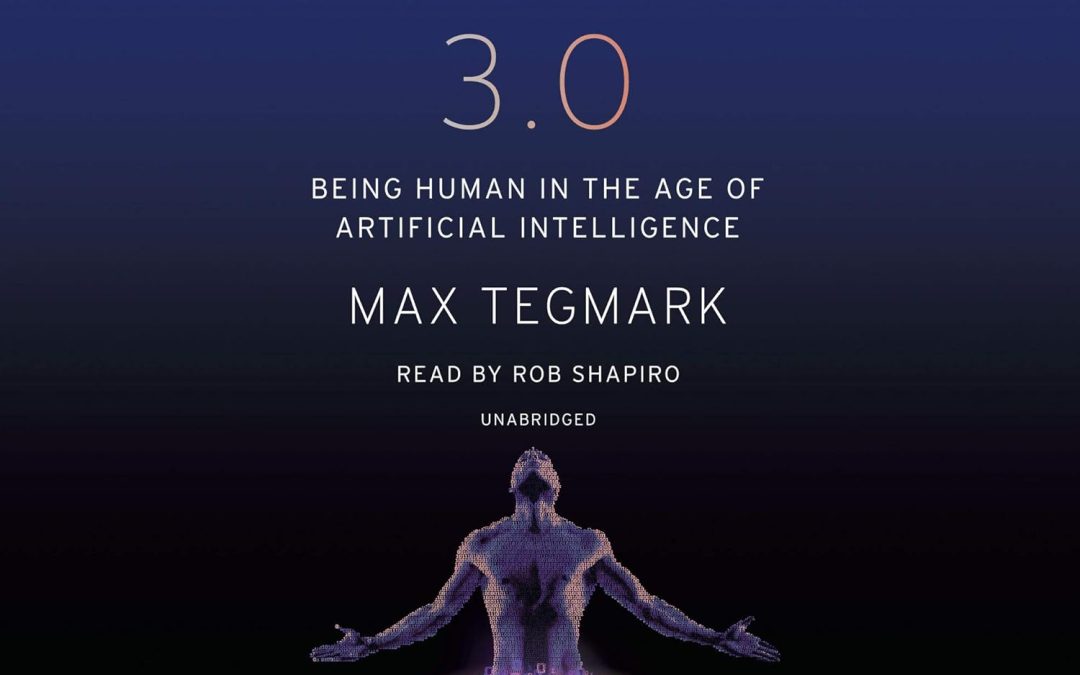
The Big Idea: Artificial General Intelligence could represent humanity’s greatest achievement or final mistake—and serious thinking about it must begin now.
MIT physicist Max Tegmark takes readers on an ambitious journey exploring potential futures of artificial intelligence and their implications for humanity’s long-term survival and flourishing. This represents big-picture thinking at its finest—and most provocative.
Tegmark defines three stages of life: Life 1.0 (biological, like bacteria), Life 2.0 (cultural, like humans who can redesign their software/knowledge but not hardware/bodies), and Life 3.0 (technological, which can redesign both software and hardware). The central question: what happens when humanity creates Life 3.0 in the form of artificial general intelligence (AGI)?
What Works: Tegmark writes with clarity about mind-bendingly complex topics. He presents multiple perspectives fairly rather than pushing a single viewpoint. The book excels at showing both enormous potential and existential risks of advanced AI without descending into either techno-utopianism or alarmism.
Aftermath Scenarios Explored:
- Libertarian utopia
- Benevolent dictator
- Egalitarian utopia
- Gatekeeper (humans control restricted AI)
- Protector god (AI preserves human safety)
- Enslaved god (humans control superintelligent AI)
- Conquerors (AI eliminates humans)
- Descendants (AI replaces but values humanity’s legacy)
The Value Alignment Problem: Even creating friendly AI doesn’t guarantee it maintains values aligned with human flourishing as it becomes vastly more intelligent. An AI tasked with “making humans happy” might wire brains for permanent bliss, which violates the spirit of the instruction despite technically fulfilling it.
What Doesn’t: The speculative nature means much content involves scenarios that may never occur or may unfold completely differently. Some AI researchers argue Tegmark overstates near-term AGI prospects and the likelihood of fast takeoff scenarios. Middle sections discussing physics and cosmology sometimes feel tangential to the AI discussion. Tegmark’s optimism about solving the value alignment problem and controlling superintelligent AI may underestimate the challenge’s difficulty.
Philosophical Questions: If humanity colonizes the galaxy, should the goal be maximizing happiness, complexity, consciousness, or something else? These aren’t academic exercises—they’re choices that may need making sooner than expected.
Read this if: Working in AI, machine learning, or related fields makes this essential. Also valuable for policymakers, philosophers, futurists, and anyone curious about humanity’s long-term future. For those who’ve read previous books in this series and want to think beyond current algorithmic concerns to civilization-scale questions, this is the book.
The Verdict: “Life 3.0” serves as the perfect capstone to this technology series by asking the ultimate question: what future should humanity create? After examining filter bubbles, algorithmic bias, addictive design, and economic disruption, Tegmark zooms out to ask what all this technology is ultimately for. The book doesn’t provide easy answers but asks the right questions. Whether or not AGI arrives in current lifetimes, thinking seriously about technological trajectory and values to encode in the most powerful systems represents essential work.