
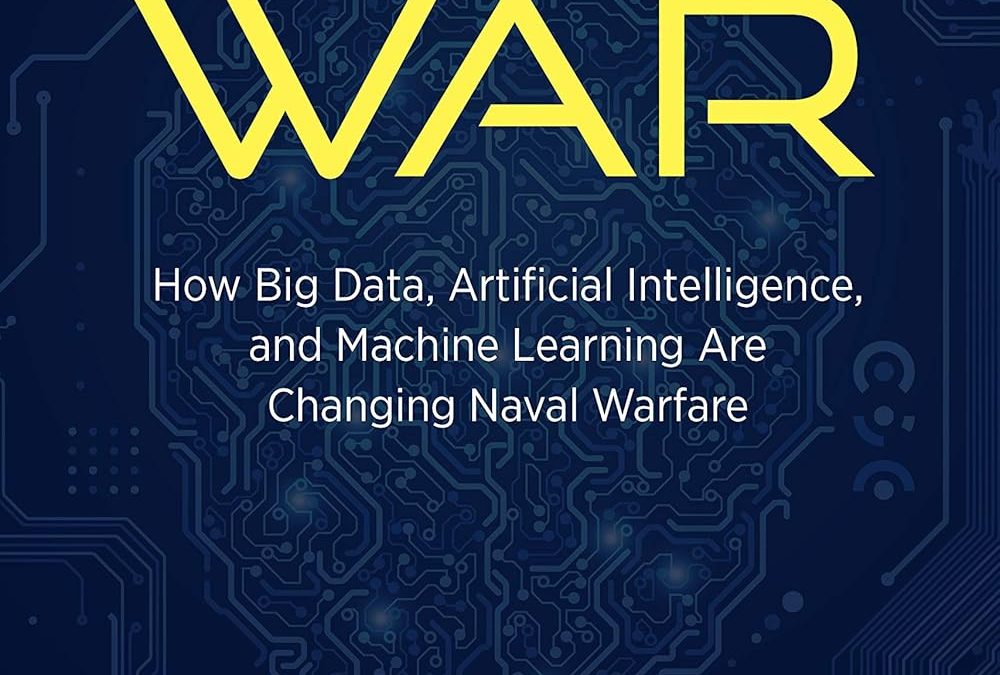
I’ll be honest—when I first picked up AI at War, I expected the usual mixture of technological hype and futuristic speculation: bold predictions about machines transforming warfare, endless references to artificial intelligence, and perhaps a few dramatic claims about a future in which human decision-making becomes secondary. This book is more measured than that. Edited by Sam J. Tangredi and George Galdorisi, AI at War is not really a book about machines replacing people. It is a book about how data, algorithms, artificial intelligence, and human judgment are increasingly becoming intertwined.
And that distinction matters.
The book brings together contributions from more than thirty experts, including military professionals, scientists, strategists, and researchers, to examine how artificial intelligence, machine learning, and big data may influence naval warfare and military decision-making. Rather than presenting a single argument, the book offers a collection of perspectives on a rapidly changing technological environment. Its ambition is not to predict the future with certainty but to help readers understand the possibilities, limitations, and challenges surrounding AI.
The central idea is deceptively simple: artificial intelligence does not operate in isolation. Its effectiveness depends on the quality of the data it receives, the systems in which it is integrated, the people who interpret its outputs, and the decisions made about how much authority should be given to technological systems.
What I found particularly refreshing is the book’s resistance to technological determinism. It does not suggest that artificial intelligence will automatically transform warfare simply because the technology exists. Instead, the contributors repeatedly return to a more complicated question: what happens when technological capability encounters human judgment, organizational culture, uncertainty, and imperfect information?
That question gives the book much of its intellectual value.
One of the strongest aspects of AI at War is its attempt to clarify concepts that are often used interchangeably. Artificial intelligence, machine learning, autonomy, big data, and automation are not identical concepts, even though public discussions frequently treat them as if they were. The book helps establish a more precise vocabulary for understanding how these technologies differ and how they interact.
This conceptual clarity is particularly important because much of the public conversation surrounding AI is driven by exaggeration. The word “artificial intelligence” often carries futuristic associations that can obscure the more practical reality of how these systems work. By moving beyond the hype, the book presents AI as a set of capabilities with genuine potential but also significant limitations.
The discussion of data is equally important. Modern decision-making increasingly depends on the ability to collect, organize, analyze, and interpret enormous quantities of information. In this environment, artificial intelligence can help identify patterns and process information at a speed that humans cannot match. Yet the book also makes clear that more data does not automatically mean better understanding. Poor-quality data, incomplete information, misleading patterns, or unexpected conditions can all produce unreliable results.
This is one of the book’s most important insights: technological speed does not eliminate uncertainty.
The book is also particularly compelling when it examines the relationship between humans and intelligent systems. Rather than presenting a simple opposition between human beings and machines, many of the contributors explore how technology may function as a tool for supporting human decision-making. AI can process information, identify patterns, and assist with complex analysis, but human judgment remains essential, particularly when situations are ambiguous or when the available information is incomplete.
The emphasis on human-machine interaction is perhaps the book’s most relevant contribution. The real challenge, the book suggests, may not be deciding whether humans or machines should make decisions. It may be learning how the two can work together without either being misunderstood. Humans can make mistakes, misinterpret information, and become overwhelmed by complexity. Technological systems can process vast amounts of data but remain dependent on the quality of their inputs and the conditions for which they were designed.
Neither side is infallible.
The book’s structure as a collection of essays is both a strength and a limitation. On the one hand, it allows readers to encounter a wide range of perspectives and applications. The different contributors bring expertise from technology, strategy, science, and military practice, creating a broad overview of the subject. On the other hand, the collection can occasionally feel uneven. Some chapters are highly conceptual, while others are more focused on specific applications or organizational questions. Readers looking for one continuous argument may find the structure less satisfying than a conventional single-author book.
The book is also ambitious in scope. It covers artificial intelligence, machine learning, big data, autonomy, decision-making, strategy, organizational change, and ethical questions. As a result, some topics receive less depth than readers might want. The book is better understood as a comprehensive introduction to a complex field than as a definitive answer to every question it raises.
Nevertheless, its greatest strength lies precisely in the questions it leaves open. AI at War does not present artificial intelligence as a magical solution to human problems. Nor does it portray technological development as something that automatically determines the future. Instead, it shows that the consequences of new technologies depend heavily on the decisions people make about how those technologies are designed, interpreted, integrated, and used.
After reading the book, it becomes difficult to think about artificial intelligence as merely a technical subject. AI is also a question of judgment, responsibility, trust, organization, and human limitation. The more powerful the technology becomes, the more important it may be to understand not only what machines can do, but also what humans expect them to do.
Perhaps the book’s most important lesson is that the future of intelligent systems will not be shaped by technology alone. It will be shaped by the relationship between data and interpretation, automation and judgment, speed and uncertainty, and technological capability and human responsibility.