
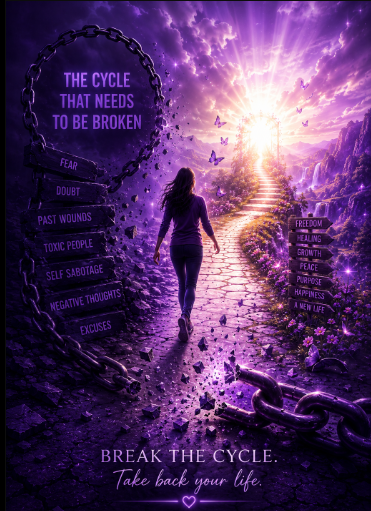
There comes a moment in a person’s life when they can no longer ignore the pattern. Not because the pattern has suddenly appeared, but because they have finally become conscious of it. We often remain inside cycles for years without realizing that we are living the same story in different forms. —but somehow the same pain returns, the same disappointments repeat, the same fears dictate our choices, and the same wounds find new ways of speaking through our lives.
A cycle does not always look like suffering. Sometimes it looks like familiarity. Sometimes it feels like loyalty. Sometimes it disguises itself as patience, forgiveness, responsibility, love, or simply the way things are.
We begin to mistake repetition for destiny. But repetition is not destiny.
A person can spend so much time adapting to a particular way of living that they eventually forget they were ever allowed to question it. What was once a response to circumstances becomes a habit. The habit becomes a pattern. The pattern becomes an identity. And eventually, the identity begins to dictate what the person believes is possible.
This is how a cycle becomes a prison without walls.
The most difficult part of breaking a cycle is not always leaving the situation itself. It is separating who we are from what we have repeatedly experienced. Because when something has been present in our lives for long enough, we can begin to believe that it belongs to us.
We say, This is just who I am. But perhaps it is not who you are. Perhaps it is who you learned to become in order to survive. There is a profound difference between the two.
Breaking the cycle therefore requires consciousness before it requires action. We must first see what has been repeating. We must recognize the choices we make automatically, the relationships we repeatedly tolerate, the fears we repeatedly obey, the boundaries we repeatedly abandon, and the wounds we repeatedly allow to determine our future.
Awareness can be painful because once we see a pattern clearly, we can no longer pretend that we do not see it. And that is where responsibility begins. Not responsibility in the sense of blaming ourselves for everything that happened to us. Some things were never our fault. Some wounds were given to us before we had the strength, knowledge, or freedom to prevent them. But what happened to us does not have to become the blueprint for everything that happens after us.
We may not have chosen the cycle. But at some point, we have to decide whether we will continue it. This is perhaps one of the hardest truths about personal transformation: healing is not merely understanding why we became who we became; it is also having the courage to become someone different. And becoming different can feel like betrayal.
Betrayal of old expectations.
Betrayal of familiar relationships.
Betrayal of the version of ourselves that learned to survive by accepting what should never have been normal. But sometimes what feels like betrayal is actually liberation.
There are moments when we have to disappoint the world in order to stop abandoning ourselves. We have to understand that peace may require us to leave places where chaos has become normal. That self-respect may require boundaries where endless forgiveness once existed. That growth may require distance from people who only recognize the version of us that was easier to control, manipulate, diminish, or understand.
Breaking a cycle means accepting that not everyone will understand the person you are becoming. And that is part of the price of freedom. Because freedom is not simply the absence of chains. Sometimes freedom is the ability to choose differently when every instinct tells you to repeat the past.
It is choosing silence instead of reacting.
It is choosing boundaries instead of endless accommodation.
It is choosing self-respect instead of begging to be understood.
It is choosing responsibility instead of blame.
It is choosing consciousness instead of living on autopilot.
It is choosing a future that has not yet been proven possible.
And perhaps this is why breaking a cycle is so frightening: you are leaving behind something you know for something you have only imagined.
The new life is uncertain. Yet uncertainty is not necessarily danger. But sometimes uncertainty is simply the space in which a different life becomes possible.
A person cannot discover who they could become while remaining permanently loyal to who they had to be.
There comes a point when survival must give way to living.
A point when the question is no longer, How do I endure this?
but rather:
What kind of life do I want to create now? That question changes everything. Because the goal is not merely to escape the past.
The goal is to stop allowing the past to govern the future. You cannot change what happened. You cannot return to the beginning and choose differently. But you can interrupt the repetition. You can become the point at which the pattern stops.
You can be the person who says: It ends with me. Not because you are untouched by the past, but because you have finally understood that carrying it forever is not the same thing as honoring it.
Some wounds do not need to be carried for a lifetime to prove that they mattered.
Some relationships do not need to be preserved to prove that they were once meaningful.
Some versions of yourself do not need to be resurrected simply because they once helped you survive.
There is dignity in letting an old version of yourself rest.
There is wisdom in recognizing when a chapter has taught you everything it was capable of teaching.
And there is courage in walking away from a familiar identity in order to discover an authentic one.
Breaking the cycle is not about becoming perfect. It is about becoming conscious.
You will still make mistakes. You will still carry memories. You will still have moments when the old pattern calls you back But every time you choose differently, you weaken the old pattern.
Every boundary you maintain teaches you that you can survive without abandoning yourself.
Every honest decision teaches you that you do not have to repeat what once seemed inevitable.
Every step forward creates evidence that another way of living exists.
Eventually, what once felt impossible begins to feel natural. And perhaps that is what freedom truly is:
not becoming someone who has never been wounded, but becoming someone who no longer allows their wounds to write the entire story.
You were not born to endlessly repeat what hurt you.
You were not meant to spend your entire life imprisoned by patterns you inherited, learned, or developed in order to survive.
At some point, someone has to become conscious enough to stop.
Someone has to question what everyone else accepted.
Someone has to refuse to pass the same pain forward.
Someone has to say:
This may have been my past, but it will not be my destiny.
And perhaps that person can be you. Because breaking the cycle is not simply about changing your life.
It is about changing the direction in which your life is moving.
It is about taking back the authorship of your existence.
It is about understanding that the past may explain you, but it does not have the authority to define you.
The cycle ends when consciousness becomes stronger than repetition.
It ends when courage becomes stronger than fear.
It ends when self-respect becomes stronger than the need to belong.
It ends when you finally understand that peace is not something you find after everyone else changes.
Sometimes peace begins when you stop participating in what destroys you.
And when you finally walk away from the cycle, you may discover something extraordinary: The life you thought you were losing was never your only possible life. You were simply standing too close to the old one to see the horizon.
Break the cycle.
Not because the past did not matter. But because your future matters too.
Not because you were never hurt. But because you refuse to make your wounds the architects of your destiny.
Not because changing is easy. But because remaining imprisoned by the same pattern has a price as well.
Some cycles are inherited.
Some are learned.
Some are created through survival.
But they do not have to be continued.
At some point, the chain has to break. And sometimes, the person who breaks it is the first person in generations who finally chooses to live differently.
The cycle ends where consciousness begins.
The past ends where courage begins.
And a different life begins the moment you decide that repetition is no longer an acceptable substitute for freedom.