
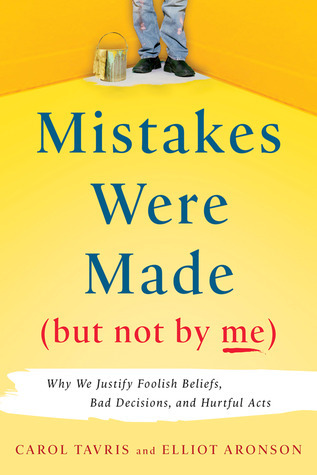
I’ll be honest—when I first picked up Mistakes Were Made (But Not by Me), I expected a fairly conventional psychology book about cognitive biases, sprinkled with amusing anecdotes about human irrationality. The title certainly suggests something lighthearted. Instead, Carol Tavris and Elliot Aronson deliver something considerably more uncomfortable. This isn’t merely a book about why people make mistakes. It’s a book about why, once we make them, we become astonishingly good at convincing ourselves that we never did.
That distinction turns out to make all the difference.
The book’s central argument revolves around one of psychology’s most influential concepts: cognitive dissonance. First developed by Leon Festinger in the 1950s, cognitive dissonance refers to the mental discomfort we experience when our actions conflict with our beliefs or our self-image. Rather than changing our behavior, Tavris and Aronson argue, we often choose the psychologically easier path—we change our interpretation of reality. We reinterpret events, revise our memories, dismiss contradictory evidence, and construct elaborate justifications that allow us to continue believing we are rational, moral, and competent people.
What makes the book so compelling is that the authors never present self-justification as a flaw reserved for other people. Politicians do it. CEOs do it. Doctors do it. Judges do it. Scientists do it. Parents do it. Couples do it. And, perhaps most uncomfortably, readers do it too. Throughout the book, there is an unmistakable message: if you think you’re immune to self-justification, you’re probably its latest victim.
I found particularly refreshing the authors’ refusal to moralize. They do not portray self-justification as evidence of dishonesty or bad character. Instead, they argue that it is a deeply human psychological mechanism—one designed to protect our sense of identity. The problem is not that we justify ourselves; the problem is that these justifications can gradually distort reality, damage relationships, reinforce prejudice, and perpetuate poor decisions long after the original mistake should have been acknowledged.
One of the book’s greatest strengths is the extraordinary range of examples it draws upon. Tavris and Aronson move effortlessly from personal relationships and family conflicts to criminal justice, politics, business scandals, medical practice, and international conflicts. Whether discussing wrongful convictions, failed military interventions, abusive relationships, or corporate misconduct, they repeatedly demonstrate the same psychological pattern: once people publicly commit to a belief or decision, admitting error becomes psychologically—and often socially—increasingly expensive.
The chapters on relationships are particularly striking. The authors explain how seemingly minor conflicts between spouses, friends, or colleagues can escalate over time, not because the original disagreement was especially important, but because each person begins constructing narratives that justify their own behavior while attributing malicious intentions to the other. The longer the conflict continues, the more difficult reconciliation becomes, as both parties become invested not merely in being right but in preserving a coherent image of themselves as the injured party.
The writing itself deserves considerable praise. Despite dealing with complex psychological theory, Tavris and Aronson write with remarkable clarity and wit. The book is filled with memorable stories, well-chosen studies, and moments of understated humor that make even its most unsettling insights surprisingly enjoyable to read. They possess the rare ability to explain sophisticated research without reducing it to oversimplified pop psychology.
That said, the book is not without limitations. Because its central framework is cognitive dissonance, readers may occasionally feel that nearly every human behavior is interpreted through the same explanatory lens. While the theory is undeniably powerful, certain phenomena might arguably benefit from greater engagement with complementary perspectives from behavioral economics, social identity theory, or contemporary neuroscience. The authors’ enthusiasm for cognitive dissonance sometimes risks making it appear more universally explanatory than it actually is.
Similarly, some of the historical examples reflect the period in which the book was written. Although the psychological principles remain highly relevant, a more extensive discussion of how self-justification operates in today’s digital environment—where algorithms, social media, and online echo chambers amplify confirmation bias—would have made an already insightful book even more timely.
Nevertheless, these criticisms are relatively minor compared to the book’s enduring achievement. Mistakes Were Made (But Not by Me) accomplishes something few psychology books manage: it changes the way you interpret both your own behavior and that of the people around you. After reading it, apologies, political speeches, workplace disagreements, family arguments, and even your own internal monologue begin to look different. You start noticing not simply whether people are wrong, but how remarkably creative they become when explaining why they couldn’t possibly be.
Perhaps the book’s greatest lesson is also its most humbling. Intelligence does not protect us from self-deception. Experience does not eliminate it. Good intentions do not prevent it. In many cases, the very qualities that make us successful also make us exceptionally skilled at defending our mistakes. Recognizing this is uncomfortable—but it is also the first step toward becoming a little more intellectually honest.
If you are interested in psychology, decision-making, leadership, conflict resolution, or simply understanding why human beings so often persist in beliefs that evidence has long since undermined, this is essential reading. It’s one of those rare books that doesn’t merely explain the mind—it quietly persuades you to distrust your own certainty. And honestly, that’s a lesson most of us could benefit from learning.