
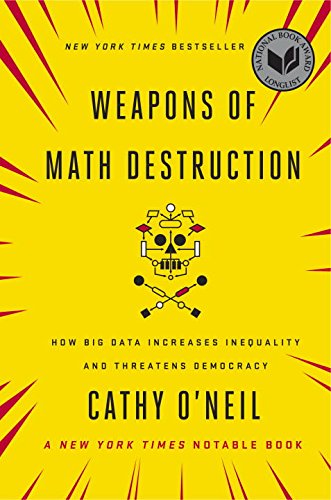
The Big Idea: Mathematical models claiming objectivity often encode bias, punish the poor, and threaten democracy—at massive scale.
Former Wall Street data scientist Cathy O’Neil delivers a devastating critique of how mathematical models and algorithms, despite claims of objectivity, frequently encode and amplify discrimination, inequality, and injustice throughout society. O’Neil introduces the concept of “Weapons of Math Destruction” (WMDs)—mathematical models that are widespread, mysterious (opaque), and destructive.
The book examines how these models operate in critical life areas: college rankings, recidivism risk assessment in criminal justice, credit scoring, insurance pricing, employee scheduling, hiring algorithms, and teacher evaluations. These systems claim neutrality and data-driven objectivity but often perpetuate existing biases, punish the poor, and create feedback loops that make bad situations worse.
What Works: O’Neil writes with clarity and moral urgency. As a mathematician who worked in finance, she brings insider credibility—not a tech skeptic from outside the field but someone who understands the mathematics and knows where it fails. Each chapter uses concrete examples of real people harmed by these systems, making abstract algorithmic injustice viscerally real.
Three Characteristics of Harmful Models:
- Opacity: Models are black boxes—those affected can’t see inside, understand decision-making, or effectively challenge outcomes.
- Scale: Unlike human bias, algorithmic bias deploys at massive scale, affecting millions instantly.
- Damage: Models create pernicious feedback loops. If an algorithm denies someone a job based on living in a “high-risk” ZIP code, that person remains unemployed, reinforcing the model’s prediction that their ZIP code correlates with employment problems.
What Doesn’t: Some readers may desire more detailed technical explanations of how specific algorithms work. The book intentionally maintains accessibility, sacrificing some mathematical depth. While O’Neil clearly identifies problems, proposed solutions—regulation, algorithmic audits, transparency—remain works in progress without clear implementation roadmaps.
Read this if: Working with data, developing software, making policy, or being assessed by algorithms (essentially everyone) makes this essential reading. Data scientists, software developers, policymakers, and citizens trying to understand how invisible mathematical systems shape opportunities and outcomes will find it invaluable.
The Verdict: “Weapons of Math Destruction” represents the most important book on this list for understanding how technology perpetuates and amplifies injustice. O’Neil doesn’t argue against mathematical models but for more ethical, transparent, and accountable systems. In an age where algorithms make life-altering decisions about healthcare, criminal justice, employment, and credit, this constitutes required reading.