
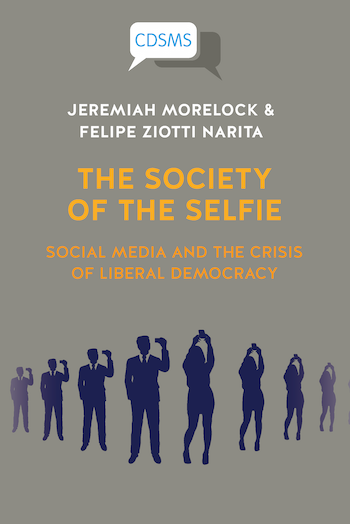
A Deep Dive into Digital Culture and Fragmented Society
In The Society of the Selfie, Jeremiah Morelock and Felipe Ziotti Narita present a profound critique of how social media reshapes individual identity and collective life. Moving beyond common concerns about screen time or online etiquette, the authors argue that platforms like Facebook, Instagram, and X (formerly Twitter) are actively fostering a new social order defined by a pervasive culture of self-presentation and validation-seeking.
Core Thesis and Framework
The book introduces the concept of the “Selfie Society”—a culture dominated by the platform-driven need for competitive self-presentation and instantaneous validation through likes, shares, and followers. Morelock and Narita, drawing on psychoanalysis (Freud and Lacan) and critical media theory, contend that this environment amplifies narcissistic tendencies, turns identity into a commodity, and fractures shared experience into personalized, often conflicting, realities.
The central concern is how this dynamic erodes the bedrock of healthy communal life. The authors posit that trust, empathy, sustained dialogue, and a sense of common ground are systematically undermined by the performative and antagonistic nature of social media interaction. The public space for meaningful exchange is replaced by a “spectacle of the self,” where communication is reduced to performance, signaling, and the mobilization of reactive emotion.
Key Strengths and Insights
Beyond Surface Critiques: The book’s major strength is its depth. It explores how the design of platforms (algorithms, interfaces, engagement-based business models) interacts with fundamental human psychology, reshaping social bonds from the inside out.
The Psychology of Fragmentation: A powerful section examines how social media provides a fertile ground for “us vs. them” thinking, the projection of negativity onto others, and the desire for simplistic, strong narratives. The authors connect this to classic psychological frameworks in a modern context.
Historical and Theoretical Depth: Grounding the analysis in thinkers like Freud, Lacan, and Debord provides a rich lens for diagnosing contemporary cultural shifts, comparing today’s digital landscape to earlier critiques of consumer culture and spectacle.
Analysis of Cultural Shifts: The book offers a nuanced look at modern social trends, viewing them as responses to the alienation and pressure for validation inherent in the Selfie Society. It examines how public figures adeptly use the platform logic to present themselves as authentic reflections of specific groups.
The Society of the Selfie is a vital and thought-provoking examination of our digital age. Morelock and Narita convincingly argue that our tools are not neutral but are actively transforming our sense of self and our relationships with others. While its sobering analysis and theoretical complexity are challenging, the book is essential reading for anyone seeking to understand the profound cultural and psychological shifts driven by social media.
It serves as a powerful reflection: when public life becomes a hall of mirrors for curated selves, the possibility for genuine, shared understanding becomes increasingly fragile.