
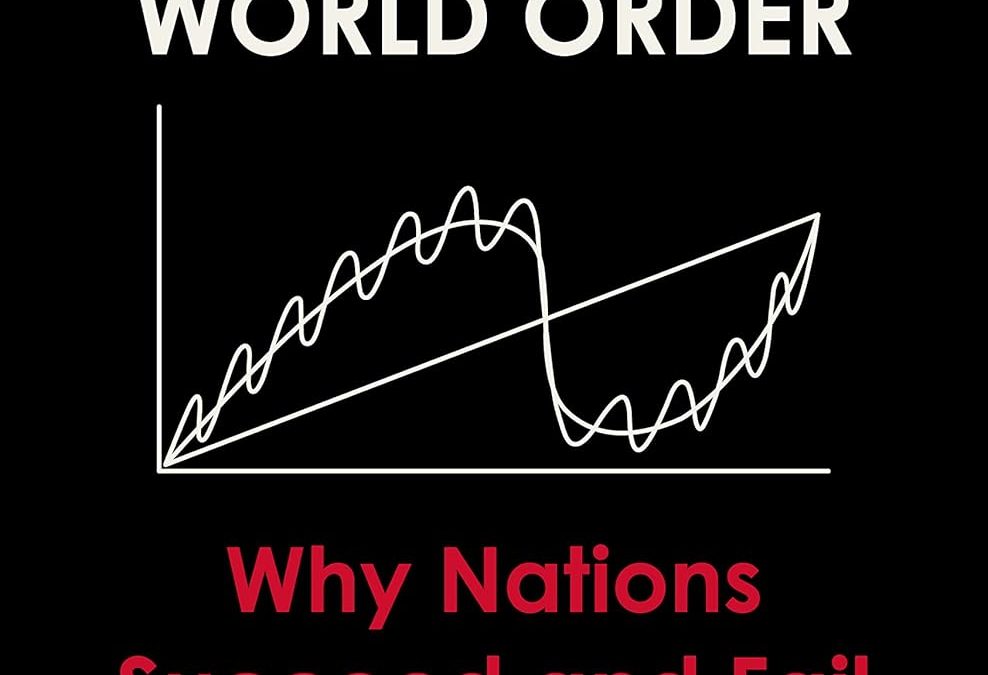
Principles for Dealing with the Changing World Order presents a macro-historical model for understanding the long-term cycles that drive the rise and fall of nations and empires. The book’s central thesis is that world orders—defined as the systems of governance, economics, and international relations—operate within predictable, mechanistic cycles driven by archetypical cause-and-effect relationships.
The book’s content is structured around a detailed analysis of these cycles, which Dalio identifies by studying the histories of major empires, most notably the Dutch, British, and American, and those of China dating back to the Tang Dynasty. From this study, he distills a recurring “Big Cycle” that all major reserve currency empires have followed. This cycle consists of three main phases:
- The Rise: A new order emerges from a period of conflict, led by strong and capable leadership. This phase is characterized by strong fundamentals: rising competitiveness, innovation, low debt levels, and increasing share of world trade and power.
- The Top: The empire reaches its peak of power and prosperity. This phase is often marked by the establishment of its currency as the world’s dominant reserve currency. However, seeds of decline are sown through excessive debt creation, rising wealth gaps, and internal political and social decadence.
- The Decline: The empire’s relative power wanes due to a combination of internal weaknesses (financial crises, political polarization, civil conflict) and the rise of strong external competitors, often leading to a great power conflict that reshapes the world order.
Dalio supports this model by identifying a set of “Eight Principal Determinants” that he uses to measure a nation’s health and position in the cycle. These determinants are: 1) Education, 2) Competitiveness, 3) Technology, 4) Economic Output, 5) Share of World Trade, 6) Military Strength, 7) Financial Center Status, and 8) Reserve Currency Status.
A significant portion of the book’s content is dedicated to applying this model to the present day. Dalio’s analysis concludes that the United States is in a state of relative decline, exhibiting classic late-cycle traits such as extreme debt levels, significant political and wealth division, and the emergence of a formidable rival in China. He posits that we are in a period of paradigm shift, where the existing world order is being challenged and a new one is yet to be established.
The tone of the book is analytical and dispassionate, framing history as a repeatable machine rather than a sequence of unique events. It is not a book of political commentary but a principles-based study of historical patterns. The content is dense with charts and quantitative measures, reflecting Dalio’s background as an investor, and is aimed at providing a framework for understanding large-scale forces in order to make better decisions in an era of profound change.